Ironman Frankfurt Race Day: Not the Full Distance I Came For, But a Race I’ll Never Forget
On Sunday, June 28th, I stood on the start line of Ironman Frankfurt ready to take on the full distance. But two days before race day, extreme heat forced the organization to shorten the bike and run. It was the right decision, but still a hard one to accept after months of preparation. This is the story of a race that did not become the Ironman finish I had dreamed of, but still gave me lessons, confidence, and proof that the work was there.
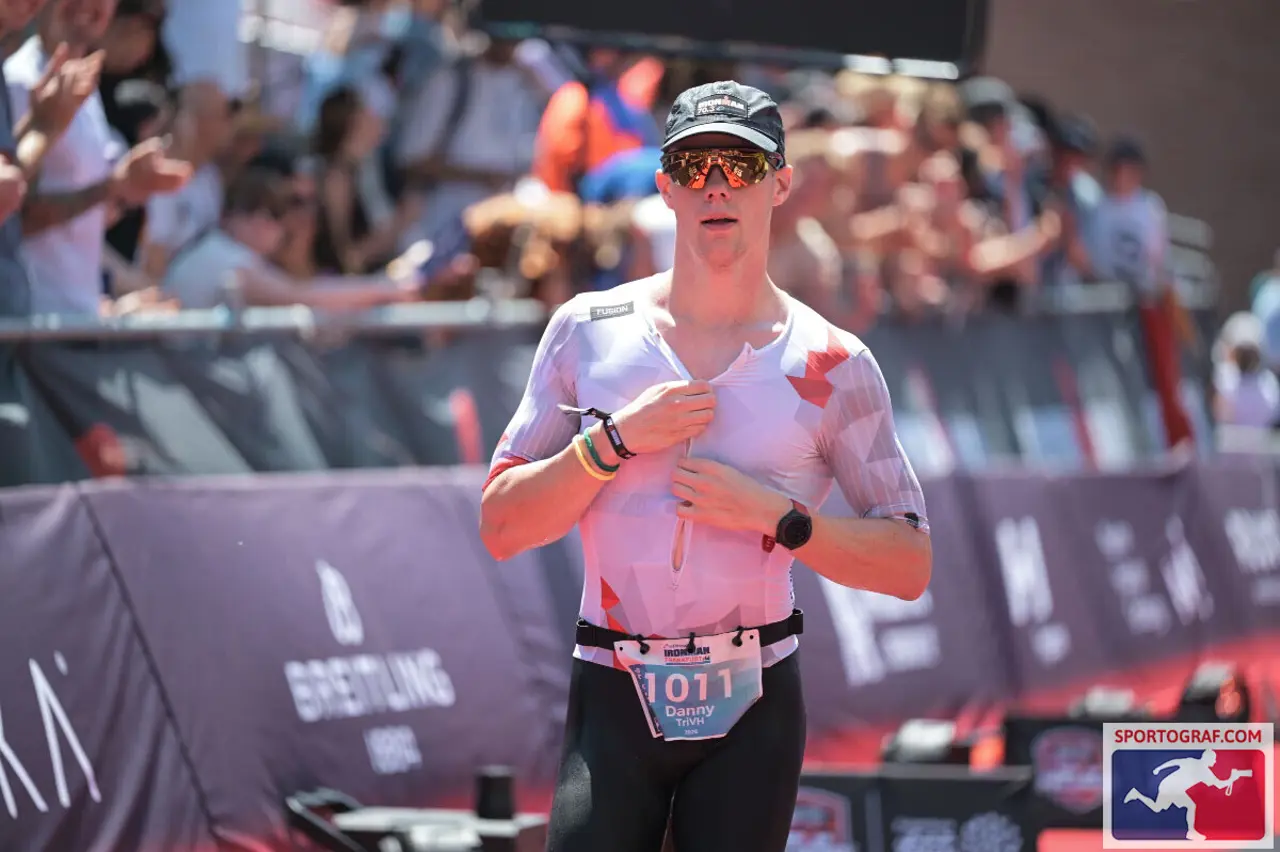
Sunday, June 28th. Ironman Frankfurt race day.
Unfortunately, just two days before the race, we got the sad news that the bike and run legs would be shortened because of the extreme heat. The decision was definitely understandable. Safety comes first, and it was going to be a brutal day.
But still, as someone who knew the heat was coming and had prepared for it rigorously, it was tough news to take. I had done the heat training, practiced my cooling strategy, and built my whole race plan around completing the full distance. So even though I understood the decision, it also meant that I wouldn’t be able to call myself an Ironman after this weekend.
That hurt a bit.
The alarm was set for 2:45 on race morning. When I woke up, I first used GOWOD to do some activation before heading to breakfast. After that, I grabbed my stuff and went to the Uber we had reserved.
We arrived at the shuttle to T1 at 3:55. The first shuttle was supposed to leave at 4:00, but we got on straight away and it left almost immediately. We got very lucky there, because later we heard that hundreds of people had to stand in line for nearly two hours.
Once I arrived at T1, I started getting everything in order. I put my bottles on the bike, pumped my tires to the right pressure, and placed my compression calf sleeves into my T1 bag, since they weren’t allowed to be worn during the swim.
Then I put on my gear, got into my swim skin, and headed towards the start.
Before entering the starting box, I did a small 200-meter warm-up, which helped a lot. The water was a whopping 29 degrees Celsius. At that time of day, the water was actually warmer than the air.
After lining up in the right starting box, I first got to watch the professionals being announced. I had met some of them just two days before, which made it even cooler. Their start was something else. Seeing them sprint into the water and disappear so quickly was incredibly motivating.
Then came the Viking clap.
Chills, but also a bit of dissatisfaction.
It is such an iconic Ironman ritual, but in my head this was not an Ironman anymore. It was a 93.1. So I chose not to fully savour it yet. I want to save that feeling for the day I actually complete the full distance.
Then the start shot sounded.
I was near the front of the first starters, but I let a few people go ahead of me. My plan was to find athletes who were slightly faster than me and try to draft behind them.
I sprinted into the water and got going.
Pretty quickly, I managed to find some feet. Whenever I got dropped by someone, I tried to immediately hook onto the next swimmer. The Aussie exit was a bit of a mess, with loads of people jumping back into the water and swimmers all around me. But I managed to stay calm and keep drafting.
One of the final straights felt like it lasted forever. I had no idea what pace I was swimming or how I was doing. All I could do was keep moving and hope I was somewhere close to the time I wanted.
When I got out of the water and saw the time, I was right where I had hoped to be.
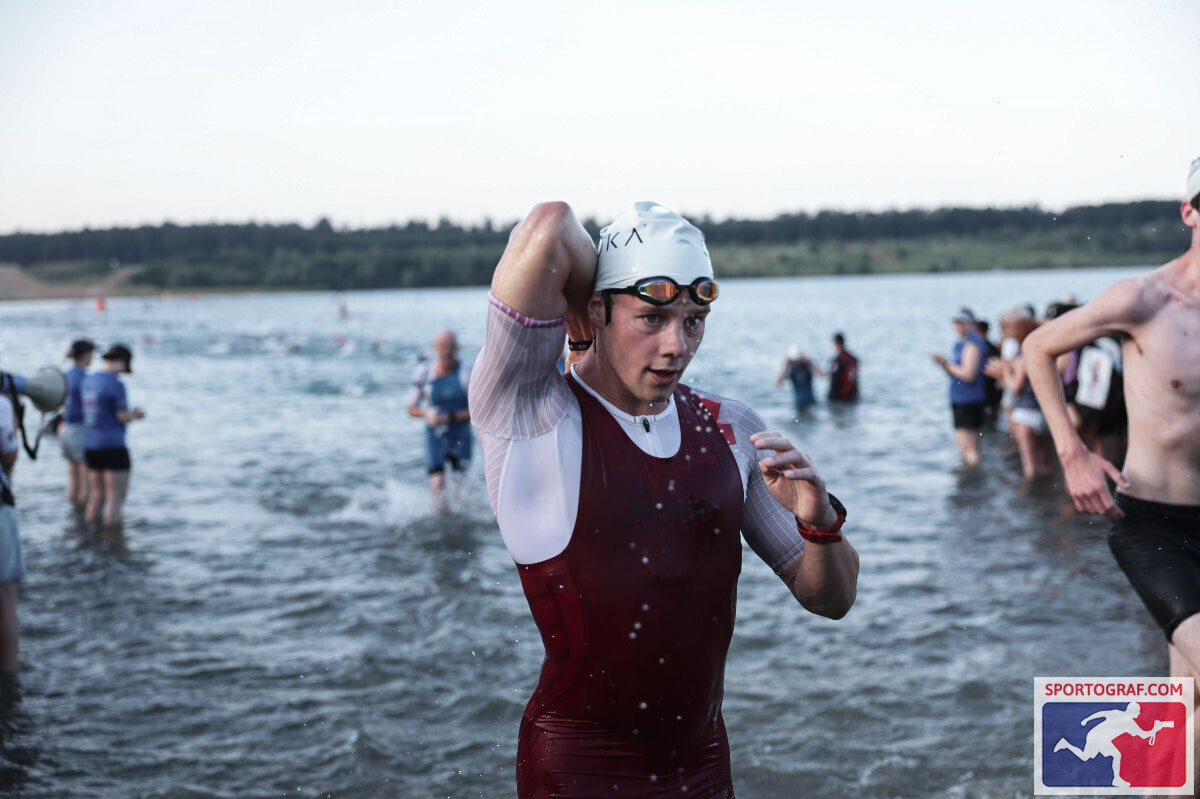
1:07:22, with an average pace of 1:46 per 100 meters.
I was extremely happy with that.
The run up the beach and uphill into transition was brutal, but I tried to get through T1 as quickly as possible.
Then it was time for the bike, probably my favourite part.
Once I got underway, it just felt easy. Almost too easy. I did not really have a proper plan anymore, because I had prepared and planned for a 175-kilometer bike ride, not a 125-kilometer one. So I decided to ride by feel.
Fairly early on, I already noticed some stomach discomfort. All my bottles contained carbs, so in order to get fluids in, I also had to take in carbs. Because of that, I had a full feeling for most of the ride, with some burping here and there. It was tough to get fuel in, but I still managed to drink two and a half of the four bottles I had with me.
At every aid station, I grabbed a bottle, took a few solid sips, and used the rest to cool myself down.
After the first lap, my family told me that I was currently the third fastest cyclist in my age group. That really surprised me.
The second lap had more traffic. I decided to follow a train that was going around the same pace as I was. The lap was a bit slower, but it also felt like I saved my legs a little.
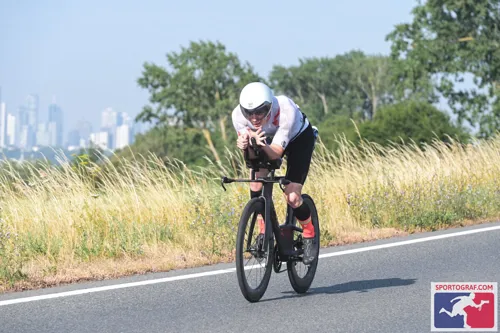
Coming into T2, I did not have the clean dismount I had in Duisburg last year. But oh well.
When I entered transition, the racks were still almost empty. I was one of the first 50 athletes into T2, and it was strangely quiet. I had a clean transition, including a quick pee break, and headed out onto the run.
As I started running, my family told me I had the fastest bike split in my age group.
That really surprised me.
The first kilometer of the run felt strong. But soon after, I noticed the stomach discomfort again. By the third aid station, I decided to start walking through them to make sure I got enough hydration and cooling in. Ice at every aid station really helped.
At kilometer 10, I took another bathroom break, this time for number two. After that, everything felt a whole lot easier. I was still walking through the aid stations, but I felt much better.
In the final two kilometers, I really had to go again. But I was so close to the finish that I decided to keep running.
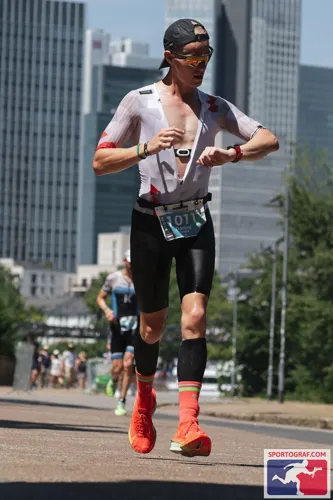
Unfortunately, earlier in the run, my zipper broke. So I ran down the red carpet and crossed the finish line while holding my trisuit closed with my hands, just to avoid getting a penalty. You have to have your zipper closed at the finish line, and I was not going to risk that after everything.
Considering the stomach issues, the heat, and two bathroom breaks, running 21.1 kilometers at an average pace of 4:37 per kilometer with an average heart rate of 140 bpm is something I can definitely be happy with.
I learned a lot from this race. I also figured out what most likely caused the stomach issues, which is valuable going forward.
On the Friday we got the news that the course would be shortened, I already signed up for Challenge Almere-Amsterdam. I had set my sights on completing a full-distance triathlon this year, and I still want to make that happen.
In the end, I finished 8th in my age group and 114th overall.
For my second ever triathlon, I am pretty happy with that.
I also wore my CORE Body Temperature sensor during the race to monitor my heat and make decisions based on the data. Interestingly, my heat strain index was highest at the start of the swim. After that, my core temperature did not really go above 38.5 degrees Celsius.
That tells me my heat training and cooling strategy worked.
So no, this was not the full Ironman finish I had been dreaming of. But it was still a race full of lessons, strong moments, and proof that the preparation was there.
Now it is time to take those lessons with me to Almere.